Broken Promises
Oakland keeps asking voters for new parcel taxes — and keeps failing to deliver what those taxes promised. What voters should weigh in deciding Measure E (June 2026).
What's inside this report
A parcel tax stack that has grown 6× faster than inflation, broken promises in three of the last four measures, and a regressive, geographically uneven burden.
Oakland collects among the highest taxes per capita in California. An inventory of the seven-to-ten overlapping parcel taxes on a typical homeowner's annual bill, and where the money has gone.
Failure to meet voter-mandated minimums in 3 of the last 4 parcel tax measures — and the continuous use of “extreme fiscal necessity” declarations to bypass them.
Two decades of using fire service threats to drive new tax approvals — and the pattern of mismanaged funds that follows.
Spending nearly doubled in 20 years. Workforce shrank. Sworn officers fell 19%. Where the money went: personnel costs.
Flat-rate parcel taxes hit deep East Oakland homes 48% harder than Rockridge homes — measured as a share of median home value.
Only 35% of Oakland's rental housing is fully rent-controlled. Federal Reserve research finds landlords pass $0.50–$0.89 of every $1 in property-tax increases through to new tenants.
A Pro/Con summary of the $34M/year parcel tax, plus five key considerations for voters about Measure E.
Executive summary
Oakland's parcel tax revenue has grown 6× faster than inflation over twenty years. Yet the city has failed to keep the staffing and service promises made in three of the last four parcel tax measures. Voters now face Measure E — a proposal to add yet another flat-rate parcel tax on top of the existing stack.
What the data shows
The City of Oakland charges some of the highest taxes per capita in California compared to similar cities.1 Yet according to the city's own financial reports and audits, basic public-safety outcomes have not improved — and in several cases have measurably declined.2
A typical Oakland homeowner now pays between seven and ten overlapping parcel taxes in addition to the baseline 1% ad valorem property tax established by California's Proposition 13.3 Voter-approved special-tax revenue has surged 379% over the past 20 years — from $31.7 million in 2006 to $152.1 million in 2025 — more than six times the cumulative increase in the Consumer Price Index over the same period.45
Despite this dramatic increase in tax revenue, the city's own reports show that it has failed to meet the staffing or service level requirements promised to voters in three of the last four parcel tax measures.6 Total city spending nearly doubled over the past 20 years to $1.69 billion in fiscal year 2025, while the city's measured service outcomes have stagnated or declined.7
Six findings at a glance
The bottom line for voters. The question on the June 2026 ballot is not whether new revenue is needed. The City of Oakland's own five-year financial forecast projects $115–$130 million annual structural deficits through 2030, driven primarily by pension and personnel obligations that no parcel tax can solve.15 The question is whether layering another flat-rate parcel tax on an already heavy stack — in a city where 70% of residents already say their taxes aren't worth what they receive in return16 — addresses the underlying fiscal problem or merely compounds it.
The highest taxes per capita
Oakland now collects more in voter-approved special taxes per resident than nearly any peer city in California. Seven to ten overlapping parcel taxes sit on top of every homeowner's annual property-tax bill — and most of them escalate annually for inflation.
An anatomy of a typical Oakland tax bill
A median-priced Oakland single-family home assessed at $650,000 is subject to roughly 33 different property-tax line items totaling about $10,254 per year — 1.58% of assessed value, well above the 1% Proposition 13 baseline, and more than 10% of area median household income.17
California's Proposition 13 (1978) capped the ad valorem property tax at 1% of assessed value and made base-rate increases politically and legally difficult. To make up the gap, California cities and school districts — including Oakland — have leaned heavily on parcel taxes for the last four decades. Parcel taxes are technically permitted as “special taxes,” and normally require a two-thirds supermajority of voters to pass.18
The result in Oakland is what amounts to a layered fiscal architecture. Each measure was approved separately, with its own promise about what the money would do. The cumulative effect is largely invisible on any individual ballot.
The current stack at a glance
| Measure (Year) | Purpose | Single-family rate | Notes |
|---|---|---|---|
| NN (2024) | City public safety — 60% police, 40% violence prevention | $198 + 10% parking surcharge | 9-year tax projected at $47.4M/year. 700-officer minimum suspended via “extreme fiscal necessity” declaration.19 |
| E (proposed 2026) | City public safety / 911 / cleanliness | $192 | In addition to, not replacing, NN. ~$34M/year for 9 years. No minimum staffing or service requirements.20 |
| G (2008) | OUSD operations | $195 | Oakland Unified School District tax. |
| G1 (2016) | OUSD teacher retention | $120 | Oakland Unified School District tax. |
| H (2022) | OUSD college / career readiness | $120 | Oakland Unified School District tax. |
| C (2022) | City library services | $114.50 (initial); ~$130+ today | 30 years, with annual inflation adjustment. City failed minimum General Fund support in year one.21 |
| D (2018) | City library services | $75 initial; >$103 in FY 2025–26 | 20-year tax. Requires $13M+ General Fund match.22 |
| Q (2020) | Parks, homelessness, litter, stormwater | $148 initial; ~$189 in FY 2025–26 | 20-year tax. Parks-maintenance requirement suspended via “extreme fiscal necessity”; ~$22M unspent by June 2023.23 |
| AA (2018) | Children's programs / Oakland Promise | $198 initial; >$262 today | 30-year tax. Approval threshold litigated for years.24 |
| MM (2024) | Wildfire prevention (defined zone only) | $99 | Annual escalation up to 5%. Applies only inside the Wildfire Prevention Zone. |
| N (1997) | Paramedic / EMS services | $7.18 initial, inflation-adjusted | Per-parcel charge. Audits flagged a growing unspent balance ($2.1M by 2011).25 |

This 379% growth understates the total picture. The line above includes only City of Oakland special taxes. It does not include the parallel growth in Oakland Unified School District parcel taxes, county taxes, or regional district assessments — all of which are also charged to Oakland property owners on the same bill.26
Broken promises
According to the City of Oakland's own February 2026 report, the city has failed to meet voter-mandated minimums in seven of twenty-one measures examined — including three of the last four parcel taxes.
The city's own admission
On February 10, 2026, City Administrator Jestin D. Johnson released a report titled “Multi-year plan to meet voter-mandated staffing and service levels.” The report examined twenty-one voter-approved tax measures and legal agreements and concluded that the city has failed to meet minimum requirements in seven of them — including three of the last four parcel-tax measures.6
Notably, voters had already approved taxes meant to fund those minimum requirements. The administrator's report estimated that fully meeting all voter-mandated staffing and service requirements would require $38.8 million per year in new ongoing revenue — almost exactly the amount the proposed Measure E parcel tax aims to raise.620
Three measures, three broken promises
The "extreme fiscal necessity" mechanism, by the numbers
The fire-station playbook
Two decades of using fire service threats to drive voter approval of new taxes — followed by mismanaged funds, broken promises, and the same pitch the next cycle.
A four-step pattern, repeated for twenty years
A review of city financial statements, audits, court rulings and ballot history reveals a recurring four-step political pattern in which fire-service cuts are used to motivate voter approval of new tax measures.27
Two decades of measures and outcomes
Measure Y (2004). Promised at least 802 sworn officers and $4M/year for fire services. The city diverted Measure Y money to other purposes; an Alameda County Superior Court judge ruled in April 2009 that the diversion was illegal, and the city admitted $11–12 million had been improperly spent.28 From 2004 to mid-2010 the city failed to meet the 803-officer minimum except for a brief six-month window, while collecting more than $100 million in Measure Y taxes.28
Measure BB (2010). After laying off 80 officers in July 2010 and dropping below the Measure Y threshold that legally barred tax collection, the city placed Measure BB on the ballot — not to restore officers, but to erase the minimum staffing requirement entirely. The Oakland Tribune editorial board urged a no vote, writing that BB would “abolish Measure Y minimum-staffing requirements altogether yet allow the city to continue collecting some $20 million a year.” Voters approved it.29
Measure Z (2014). Renewal campaign warned of severe fire cuts; passed by two-thirds majority. Earmarked only $2M/year for fire — half of Measure Y's allocation — despite a higher overall revenue base.30
Measure NN (2024). Passed with over 70% support on the promise of a 700-officer minimum and 480-firefighter minimum. The city was already below both thresholds when voters approved it, and quickly declared “extreme fiscal necessity” to bypass them while continuing to collect the tax.19
Measure E (proposed, 2026). Same playbook, fewer safeguards: the lead signatory of the official argument in favor is the firefighters' union president, and the opening pitch asks voters to “save our essential services” and “keep fire stations open.” The new tax would be in addition to, not replacing Measure NN, and contains no minimum public-safety staffing or service-level requirements.2031
An example: January 2025
In January 2025, the city closed two fire stations and proposed closing a total of seven — representing roughly 30% of Oakland Fire Department capacity — after the hoped-for sale of the Oakland Coliseum was delayed and $60 million the city council had prematurely budgeted from the sale failed to materialize. The firefighters' union held press conferences warning of life-threatening response-time delays. After intense public pressure, the council found money to reverse some closures.32
Shrinkflation
Total spending nearly doubled in twenty years. The workforce shrank by 4%. Sworn officers fell 19% from peak. Where did the money go?
Paying more, getting less
The city's data shows almost no long-term improvement in basic-service outcomes — even as spending and tax revenue climbed.

What did and did not change, 2006–2025
- Total spending: +95%, from $0.87B to $1.69B.7
- Voter-approved special tax revenue: +379%, from $31.7M to $152.1M.5
- City full-time-equivalent workforce: –4%, from 3,614 to 3,487.7
- Sworn police officers: –19%, from a peak of 837 in 2008 to 678 in 2025 — below the 700-officer minimum promised under Measure NN.719
- Physical arrests: –57%, from 14,908 in 2007 to 6,338 in 2025.7
- 9-1-1 response times: Among the worst in California for over a decade; have failed state standards.10
- Authorized new dwelling units: –71%, from 1,641 in 2016 to 472 in 2025.7
Where the money went
In 2023, the average total compensation (salary plus benefits) for a full-time City of Oakland employee was $237,000 — a 79% increase over 10 years, and more than twice the median Oakland household income of approximately $102,000.3334
Oakland's relative compensation premium is driven not by base salary — which is roughly comparable to peer cities — but by benefits worth 72% on top of base pay, compared with 41% in Long Beach, 31% in Sacramento, and 33% in San Francisco.35
Annual pension benefit payments alone grew from $362 million in 2016 to $477 million in 2025 — a 32% increase in nine years.7 The city's own five-year forecast projects $115–$130 million annual structural deficits through the end of the decade.15
Who actually pays
A flat-rate parcel tax is not the same as a flat impact. Geographic data show the burden falls hardest on the East Oakland homeowners least able to absorb it — precisely the residents the city has elsewhere committed to protect.
Geographic disparity: a 48% gap
Because parcel taxes are flat dollar amounts that ignore property value, the same $192 hits a $400,000 home harder than a $1.6 million home. Property data show the effective parcel tax burden varies dramatically by zip code.11
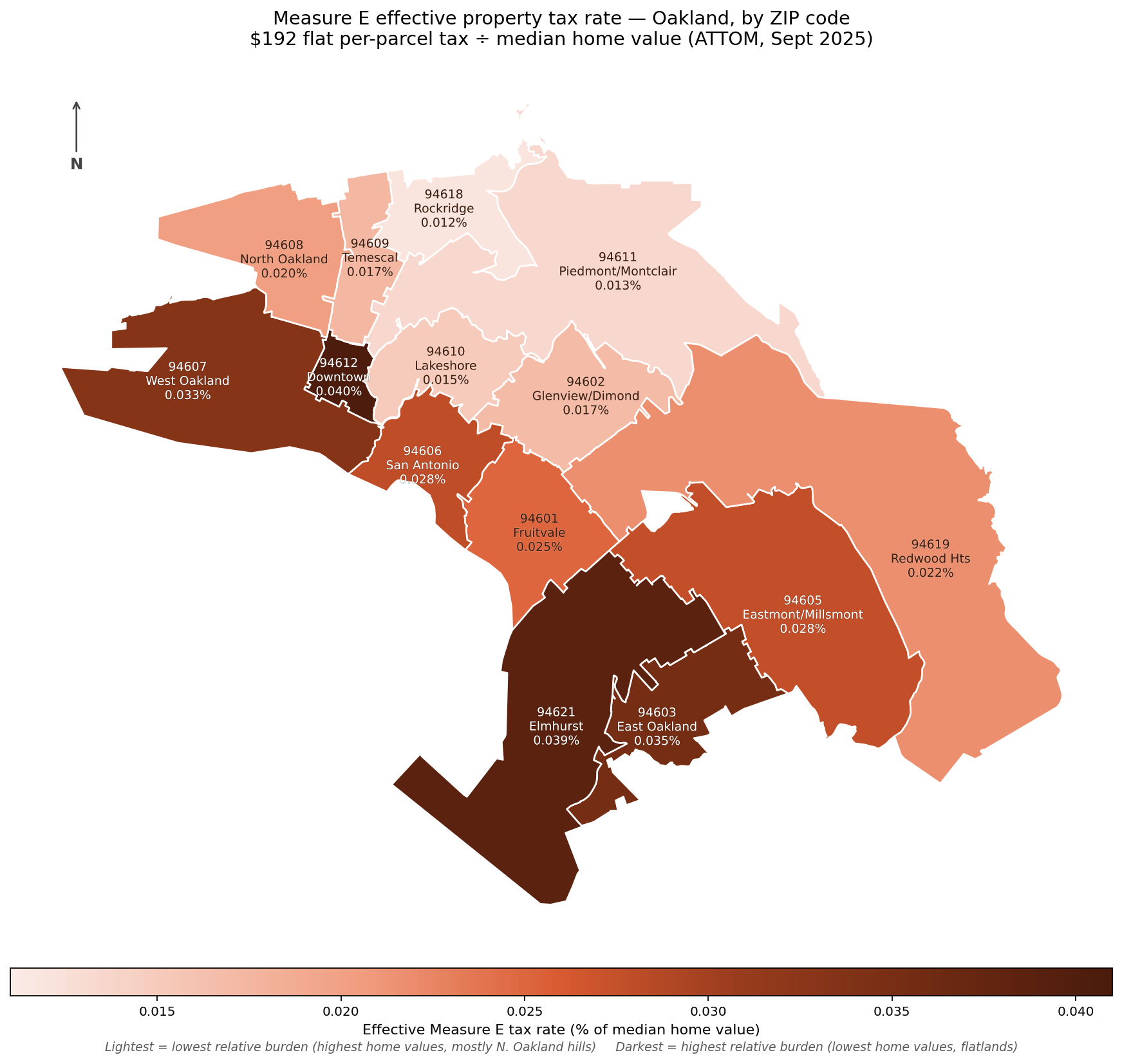
Over the 20-year life of the proposed Measure E tax, a typical deep East Oakland homeowner would pay over three times the share of their housing wealth compared with a typical Rockridge homeowner, for the same citywide public safety services. The cumulative $3,840 in parcel tax payments (before inflation escalators) would equal 0.24% of a Rockridge home's value but 0.81% of a deep East Oakland home's value.11
Why this pattern matters
Empirical studies from the Institute on Taxation and Economic Policy and Brookings have documented that flat-rate property assessments produce a disparate racial impact even where the tax is nominally neutral, because of cumulative differences in assessed values, homeownership rates, and effective rates.3637
In Oakland, this pattern coincides with a documented historical legacy. The 1937 Home Owners' Loan Corporation residential security map graded West Oakland, Fruitvale and the East Oakland flatlands “red” or “yellow” — denying federally insured mortgages to non-white families funneled into those neighborhoods by restrictive covenants and racially zoned subdivision ordinances, a de jure segregation documented at length in Richard Rothstein's The Color of Law.38 A flat parcel tax is not racially discriminatory in itself, and correlation does not affirm causation. The data nevertheless show that the same neighborhoods once shaded red on those maps now sit at the top of the parcel-tax-burden curve.11
Black households in Oakland today have the highest mortgage denial rates of any racial group; a 2018 analysis found that Black households in San Francisco–Oakland could afford only 5% of available home listings — the lowest share of any major U.S. metropolitan area.3940 Oakland's Black population has declined by 33% since 2000, even as it rose nationally.41

Renters pay too
A common defense of parcel taxes is that they fall on landlords, not renters, because of Oakland's rent control. The data show this protection covers a much smaller slice of the rental market than most people realize — and in the long run, parcel taxes pass through almost entirely.
The rent-control myth
Most discussion of who pays a parcel tax assumes the cost falls on property owners. For roughly 58% of Oaklanders — the majority who rent — that assumption is wrong, both in the short run and especially over time.
The two-thirds of Oakland's rental market that is not fully covered by local rent control is subject only to California's AB 1482 statewide cap (5% plus inflation, or 10%, whichever is lower). Within that cap, landlords can raise rents to recover any cost increase, including parcel taxes.
Three mechanisms that erode rent control over time
Vacancy decontrol. Under California's Costa-Hawkins Act, when a tenant moves out the landlord can reset the rent to whatever the market will bear. Each turnover effectively resets the building's rent to a level that incorporates accumulated tax increases.42
Fair-return petitions. Landlords who can show that the local rent cap doesn't allow a reasonable profit can petition the Rent Board for a larger increase, with property taxes counted as a recoverable operating expense.14
Capital improvement pass-throughs. Landlords can petition to pass up to 70% of building improvement costs through to tenants. While not a direct tax pass-through, this is a related rent-increase mechanism that operates alongside cost recovery.14
The empirical evidence on pass-through
A 2020 U.S. Census Bureau study examining small multifamily buildings (1–5 units) found a short-term pass-through rate of roughly 14% — confirming measurable upward rent effects even for small tax changes.43 A German market study covering decades of property tax data found that real rents fully absorbed property-tax increases within approximately three years, meaning long-term pass-through approaches 100% in supply-constrained markets like Oakland.44
Stacked across all per-unit multi-family parcel taxes, a small-building Oakland tenant can absorb $250–$400 per year in pass-through parcel tax alone — and because parcel taxes are per unit rather than scaled to value, tenants in small, older buildings (typical of historically redlined neighborhoods such as West Oakland and Fruitvale) absorb a higher per-dollar-of-rent tax burden than tenants in new luxury towers near downtown.11
Measure E (June 2026)
A new $192-per-parcel tax raising $34 million per year for nine years — in addition to, not replacing, the Measure NN tax voters approved in 2024.
Anatomy of the ballot question
Measure E would create a new City of Oakland parcel tax of $192 per single-family parcel and $131 per multi-family unit per year, raising approximately $34 million annually for nine years. The official ballot text says it would prevent longer 911 response times, keep fire stations open, prevent cuts to fire protection and police patrols, and address homelessness, dumping and litter.20
Crucially, Measure E would be in addition to, not replacing, the Measure NN parcel tax voters approved less than two years earlier in 2024. There is no enforceable minimum number of officers, firefighters, or other public safety personnel attached to the measure, and outside the political promise in the ballot title, the spending discretion is largely unconstrained.20
How it qualified for the ballot
Measure E qualified through a paid signature-gathering campaign sponsored by Oakland's public-employee unions and submitted as a “citizen-sponsored” initiative. Under California law, a special tax placed on the ballot by a city council requires two-thirds (66.67%) voter approval; a citizen-sponsored initiative needs only a simple majority (50% plus one).45
Per California Form 460 campaign-finance disclosures filed February 2, 2026:46
- SEIU Local 1021: $200,000
- IAFF Local 55 (firefighters' union): $150,000
- IFPTE Local 21: $50,500
- Pacific Gas & Electric Co. (PG&E): $50,000
- Total contributions to the campaign: over $400,000
Where the money would go

The deals would consume roughly 44% of the new tax annually. The raises continue every year and would total roughly $134 million over the nine-year life of the tax.47
The contractual trigger is based on a city-produced forecast at the third quarter of the fiscal year — before the year is even completed. Even if the parcel tax were to fail in June and final year-end financials were to show a deficit, it would be too late to rescind the pay raises.49
Measure E — at a glance
- Promised services. Funds 911 dispatch, fire stations, police patrols, crime prevention, homelessness response, dumping & litter cleanup.
- Lower-income protection. Includes exemptions for qualifying low-income households and seniors.
- Lower per-rental rate. The $131/unit rental rate is lower than the $192 single-family rate.
- Rent control. Oakland's rent-stabilization ordinance limits direct, immediate pass-through to tenants of some rent-controlled units.
- Oversight built in. The measure includes public disclosure, citizen oversight and independent audits.
- Cuts coming? Without new revenue, the city says reductions to basic services will be necessary.
- Prop 13 context. Proponents argue Prop 13 (1978) capped base property-tax revenue, justifying parcel taxes to make up the gap.
- Past support. Oakland voters have routinely approved similar parcel-tax measures.
- Broken promises. The city's own Feb. 2026 administrator's report admits failure to meet voter-mandated minimums in 3 of the last 4 parcel taxes.
- Oakland already has the highest taxes in the state. Oakland's special taxes have increased 379% in the past 20 years, meanwhile Oaklanders receive some of the worst services in the state on several metrics.
- Renters pay too. Only 35% of Oakland's rentals are fully rent-controlled; Federal Reserve research finds $0.50–$0.89 of every $1 in tax hikes is passed to new tenants.
- Hits East Oakland 48% harder. Flat-rate parcel taxes are regressive; deep East Oakland homes pay up to 48% more as a share of value than Rockridge homes.
- It adds, doesn't replace. Measure E is on top of Measure NN (2024) — already a 7-to-10-layer parcel tax stack.
- Trust deficit. 70% of all residents — 75% of Black residents — say their taxes already aren't worth it.
- No staffing minimums. Unlike Measure NN, Measure E does not require a minimum number of officers, firefighters, or other public-safety personnel.
- No binding spending limits. Outside the political promise in the ballot title, oversight is essentially advisory.
- “Extreme fiscal necessity” loophole. The city has continuously declared “extreme fiscal necessity” to bypass voter-mandated minimums while still collecting the tax.
- Won't fix the gap. Oakland's own 5-year forecast projects $100M+ structural deficits through 2030, driven by pension/personnel costs no parcel tax can solve.
Endnotes & sources
- Neditch, Nicole et al. “Balancing Oakland's Budget: Nine Recommendations for Closing the City's Structural Deficit.” San Francisco Bay Area Planning and Urban Research Association (SPUR), May 2025, p. 17. https://www.spur.org/sites/default/files/2025-05/SPUR_Oakland_Budget.pdf
- Office of the City Auditor (Houston, Michael). “Inadequate 9-1-1 Staffing and Outdated Beat Boundaries Lead to Slow and Inequitable Police Emergency Response Times.” City of Oakland, Oct. 10, 2025.
- Reinhart, Sean S. “Oakland taxes hit deep East Oakland's homes up to 48% harder than Rockridge's.” Oakland Report, Apr. 20, 2026.
- U.S. Bureau of Labor Statistics. “Consumer Price Index, U.S. City Average, 2006–2025.” Accessed Apr. 13, 2026. https://www.bls.gov/cpi/
- City of Oakland. “Annual Comprehensive Financial Reports, fiscal years 2006–2025.” Schedule 5: tax revenues by source.
- City of Oakland. “Multi-year plan to meet voter-mandated staffing and service levels.” Finance and Management Committee, Feb. 10, 2026, agenda item #6. https://oakland.legistar.com/LegislationDetail.aspx?ID=7803529
- City of Oakland. “Annual Comprehensive Financial Report, fiscal year ended June 30, 2025.” Statistical sections: FTE by Function/Program; Operating Indicators; Changes in Fund Balances. Dec. 30, 2025.
- Reinhart, Sean S. “Oakland set to declare ‘extreme fiscal necessity’ again, coordinate with unions to increase property taxes.” Oakland Report, Feb. 10, 2026.
- Oakland Report contributors. “Oakland's surplus mirage sets the stage for a $34 million tax increase.” Oakland Report, Feb. 28, 2026.
- Office of the City Auditor (Houston). Op. cit. (note 2).
- Reinhart, Sean S. “Oakland taxes hit deep East Oakland's homes up to 48% harder than Rockridge's.” Oakland Report, Apr. 20, 2026; underlying property-value data from ATTOM, “Oakland, CA Real Estate & Property Data,” accessed Apr. 20, 2026.
- U.S. Census Bureau. American Community Survey 5-Year Estimates by ZIP Code Tabulation Area, City of Oakland.
- Baker, Sarah. “Property tax pass-through to renters: a quasi-experimental approach.” Federal Reserve Bank of Philadelphia, December 2025.
- City of Oakland. “Rent Adjustment Program annual report fiscal year 2024-25.” Oct. 21, 2025. https://oakland.legistar.com/LegislationDetail.aspx?ID=7666836
- City of Oakland. “Fiscal Year 2026-30 five-year financial forecast.” Oakland Redevelopment Successor Agency / City Council, June 3, 2025, agenda item #9. https://oakland.legistar.com/LegislationDetail.aspx?ID=7399425
- Taylor, Loren. “75% of Black Oakland residents surveyed say the taxes they pay are not worth it.” Oakland Report, Mar. 21, 2026.
- Reinhart, Sean S. “The city of Oakland has broken its promises to voters in three of the last four parcel tax measures.” Oakland Report, Apr. 8, 2026.
- California Taxpayers Association (CalTax). “The other property tax: an overview of parcel taxes in California.” March 2013.
- Ballotpedia contributors. “Oakland, California, Measure NN, Police and Violence Reduction Parcel Tax Measure (November 2024).” Accessed Apr. 8, 2026.
- Ballotpedia contributors. “Oakland, California, Measure E, Create Parcel Tax to Fund Public Safety Programs Measure (June 2026).” Accessed Apr. 23, 2026.
- Office of the City Auditor (Houston, Michael). “Audit of library parcel taxes for Fiscal Year 2019–20 through FY 2022–23.” City of Oakland, June 13, 2024.
- Ballotpedia contributors. “Oakland, California, Measure D, Parcel Tax for Library Services (June 2018).” Accessed Apr. 8, 2026.
- Office of the City Auditor (Houston, Michael). “Budget transparency, performance management, and stronger oversight needed to ensure Oaklanders benefit from the 2020 Parks and Recreation Preservation, Litter Reduction, and Homelessness Support Act.” City of Oakland, Dec. 21, 2023.
- Ballotpedia contributors. “Oakland, California, Measure AA, Education Parcel Tax Charter Amendment (November 2018).” Accessed Apr. 8, 2026.
- City of Oakland. “Resolution No. 73312, Paramedic Services Special Tax (Measure N).” Feb. 25, 1997. https://cao-94612.s3.amazonaws.com/documents/73312-CMS.pdf
- Reinhart, Sean S. “Shrinkflation: Oakland is charging residents more and giving them less.” Oakland Report, Apr. 15, 2026.
- Reinhart, Sean S. “Oakland union boss threatens fire station closures unless voters approve tax hike – despite the city's past broken promises.” Oakland Report, Apr. 13, 2026.
- Ballotpedia contributors. “Oakland Parking Lot and Parcel Tax, Measure Y (November 2004).” Accessed Apr. 13, 2026; California Court of Appeal, First Appellate District, Sacks v. City of Oakland (2010).
- Oakland Tribune editorial board. “Oakland Tribune editorial: No on Oakland Measures X, W, BB.” Oakland Tribune, Sept. 23, 2010.
- Ballotpedia contributors. “Oakland, California, Measure Z, Public Safety Parcel Tax (November 2014).” Accessed Apr. 13, 2026.
- City of Oakland. “Argument in Favor of Measure E.” Filed in the Office of the City Clerk, Mar. 18, 2026.
- Ko, Kevin. “2 Oakland fire stations closed because of budget shortfall; firefighters warn of life-threatening delays.” CBS News, Jan. 6, 2025; Rhoades, Callie. “‘It would be catastrophic’: After Keller Fire, Oakland officials caution against OFD cuts.” Oaklandside, Oct. 22, 2024.
- Ubell, Michael and Tim Gardner. “Oakland employee compensation grew 2.5 times faster than inflation, far outpacing other cities.” Oakland Report, Jul. 9, 2024.
- U.S. Census Bureau. “American Community Survey 1-Year Estimates (2006–2024), Oakland city.” Accessed Apr. 15, 2026.
- Transparent California. “California public pay and pension database.” Accessed Apr. 15, 2026.
- Davis, Carl et al. “Taxes and Racial Equity: An Overview of State and Local Policy Impacts.” Institute on Taxation and Economic Policy, Mar. 31, 2021.
- Fields, Jordan et al. “How the Property Tax System Harms Black Homeowners and Widens the Racial Wealth Gap.” Brookings, Aug. 22, 2023.
- Rothstein, Richard. The Color of Law: A Forgotten History of How Our Government Segregated America. Liveright, 2017.
- Housing Policy Finance Center. “Keys Unlock Dreams: Oakland.” Urban Institute, January 2024.
- Fernandez, Lisa. “Black households in San Francisco, Oakland have fewest home-buying options in U.S.: Zillow.” KTVU, Apr. 12, 2018.
- Hwang, Jackelyn et al. “Neighborhood change and residential instability in Oakland.” Federal Reserve Bank of San Francisco, May 2021.
- California Civil Code § 1954.52 (Costa-Hawkins Rental Housing Act).
- Schwegman, David and John Yinger. “The Shifting of the Property Tax on Urban Renters: Evidence from New York State's Homestead Tax Option.” U.S. Census Bureau Center for Economic Studies, December 2020.
- Löffler, Max and Sebastian Siegloch. “Welfare Effects of Property Taxation.” CESifo Working Paper, March 2021.
- Fracassa, Dominic. “Judge says SF correct in passing two tax measures on simple majority vote.” San Francisco Chronicle, July 5, 2019.
- California Form 460. “Recipient Committee Campaign Statement.” Oaklanders For A Safe, Clean & Healthy City, Sponsored By Labor Organizations, Feb. 2, 2026.
- Reinhart, Sean S. “44% of Oakland's proposed $34 million tax increase would go to union payouts.” Oakland Report, Feb. 22, 2026.
- City of Oakland. “Approve the MOU between the City of Oakland and miscellaneous unions.” Special concurrent meeting of the Oakland Redevelopment Successor Agency / City Council, Sept. 15, 2025. https://oakland.legistar.com/LegislationDetail.aspx?ID=7651498
- Reinhart, Sean S. “Oakland: $34 million property tax increase appears headed for June ballot.” Oakland Report, Mar. 3, 2026.